The main pronunciation challenges for native English speakers in German are:
- Umlauts ä, ö, and ü
- The two ch sounds in ‘ich’ and ‘ach’
- Rolled or guttural r
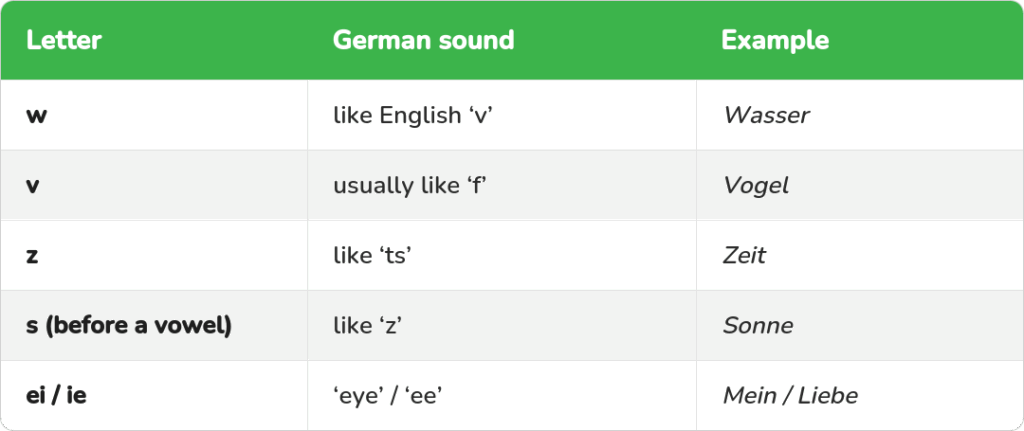
- Letters found in English that are pronounced differently in German, such as w, v, and z
Private German lessons for adults can make learning far easier because a tutor can hear and correct your pronunciation in real time.
A Closer Look at Common Speaking Challenges
German is actually a very consistent language. Once you know the rules, you can sound out words based on how they’re spelled. This predictability works in your favor because it can make it easier to master pronunciation.
Here are some specific hurdles and how to clear them:
Umlauts: ä, ö, and ü
These vowels have no exact English equivalents, which is why they feel awkward at first.
- ä is close to the e in ‘bet.’
- ö is made by saying ‘ay’ while rounding your lips.
- ü is made by saying ‘ee’ while rounding your lips.
Lip-rounding is the key. English speakers tend to drop their lips, which turns über into something closer to ‘oober.’ Practicing in front of a mirror can go a long way to mastering how these letters are pronounced.
The Two 'Ch' Sounds
The ch in ich is soft, formed near the front of the mouth, while the ch in ‘ach’ is harder and comes from the back of the throat. English has neither sound, so learners often substitute a k or a ch. Both versions of ch lead to common mistakes adult German learners make and can be learned by feeling where the sound is made in your mouth.
The German 'R'
The German r is usually rolled lightly or made at the back of the throat, unlike the English r. At the end of syllables, it often softens to almost a vowel sound, as in the word ‘vater.’ Trying to use an English r is a tell-tale sign you’re a non-native speaker, so this simple correction can make all the difference in how you present yourself.
Letters That Change Their Sound
Several letters used in English behave differently in German, which can trip up readers who pronounce them as they would in English:
Word Stress And Clear Endings
German generally stresses the first syllable of base words, and word endings must be pronounced clearly rather than swallowed because they contain grammatical meaning. English speakers often rush or soften German endings out of habit, so slowing down slightly and finishing each word is one of the simplest ways to speak more clearly.
How To Improve Your Pronunciation
Adults can improve their pronunciation fastest through active, spoken practice. Here are a few ideas on how to do this:
- Listen and imitate short clips of native speakers, copying rhythm and melody.
- Record yourself and compare, since your ear improves before your mouth does.
- Focus on one sound at a time instead of trying to fix all your mistakes at once.
- Practice out loud daily. Pronunciation is a physical act and needs repetition.
Practicing German conversation as an adult one-on-one with a teacher is an incredibly effective way to improve pronunciation. A learner from Zurich explains the value of personal attention: “The teacher corrects things that no group teacher has time for, pronunciation habits, word order, the ‘werden’ vs ‘wollen’ thing.” After just three sessions, he could speak German with his Swiss colleagues without panicking.
Speak German More Clearly
Pronunciation is a skill, not a talent, that improves quickly with focused feedback. German Academy Zurich pairs you with an expert teacher who helps you speak more clearly and feel more confident from the first session. Reach out to us today to start speaking German more clearly, sooner!