
Distractions are part of everyday life and can get in the way of even the best intentions. To keep your language learning on track, set reasonable goals for your private German lessons for working adults, as well as for your independent practice.
This requires that you clearly define the reason you are learning German and then establish specific, measurable, achievable, relevant, and time-bound (SMART) goals to track your progress.
Why Are You Learning German?
Different people learn German for different reasons. It could be work-related, a requirement for a visa, or for pleasure.
How you learn a language should be tailored to your needs and interests. For example, a tourist may want to learn how to ask for directions, order a meal at a restaurant, or ask about interesting places to visit. A businessperson, on the other hand, needs to learn industry-specific vocabulary and how to write emails to colleagues using culturally appropriate terminology.
The learning program you choose should align with your needs and focus on the core skills (listening, speaking, reading, or writing) you need to succeed. The rest will come naturally as your language skills improve.
The SMART Framework Explained
The SMART framework was first described in a 1981 article in Management Review. It has been widely adopted by the business world, educators, and psychologists to support project management, academic achievement, and personal improvement.
SMART stands for:
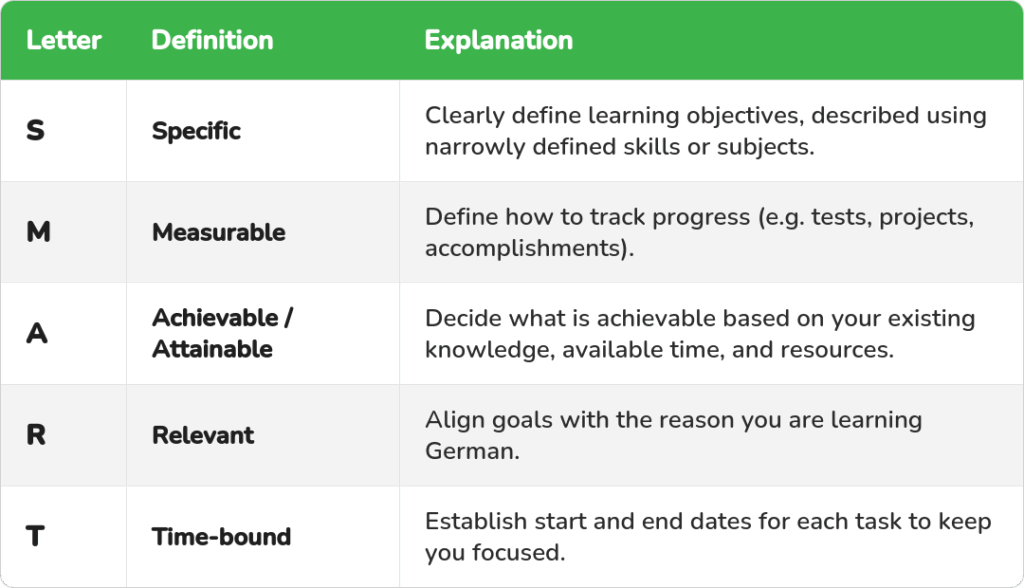
Write down the details of your goals. Don’t rely on your memory or vague plans to reach the level of proficiency you want.
Rather than saying, “I want to speak German better,” set a goal that aligns with the SMART criteria. Examples of SMART goals include:
- Learn ten German words each week for two months and pass a specific quiz that covers German language basics for Americans abroad.
- Watch the second episode of 60 Minuten on Netflix before Sunday and write down five words you didn’t know.
Your SMART goals will help create a roadmap for learning German based on your individual needs and capacity.
Goal-Setting Suggestions to Support Language Learning
Track how well you’re progressing toward your goals using time management tactics for language-learning adults. If you’re falling behind, perhaps the goals are too ambitious and need to be adjusted.
Create a menu of activities that can accommodate different energy levels. There will be days when you’re bursting with curiosity and are ready to learn; there will be other days when you feel too tired to try anything new.
By having a variety of lessons in your back pocket, you don’t have to skip your German lesson when you’re running low on energy. Instead, you can do something simple like practicing vocabulary with flashcards or an interactive app.
Keep Your Language Learning on Course
German Academy Zurich understands the demands of everyday life and can help you set goals to achieve the proficiency level you need. Our learning approach combines one-on-one tutoring with a robust AI-powered learning platform to deliver the best results possible!